
Everything is a cube
There is not a single classic sprite in Donutello 2. The wall, the lamp, a drop of sludge and the donut himself are all built from tiny cubes, voxels. When Donutello bumps his head into a cookie block, the block does not dissolve in an animation. It bursts into the cubes it was built from. Each one flies its own way, bounces off the ground, and some head straight for the camera.
That is why we did not build the game in an off-the-shelf 2D engine. We wanted a world you can really break, light up and let cast shadows.
Pixlix, our engine
Pixlix is an engine for worlds made of cubes that we write ourselves at Voxel Division. It was created for Braintown and a voxel model of the city of Olomouc: it handles an endless city assembled from tiles, day and night, pedestrians and cars. Donutello 2 takes its core, the world format and the renderer, and builds its own game on top.
| Language | Rust. The whole game including the engine, the arena server and the tools is over 60 thousand lines. |
|---|---|
| Graphics | wgpu. It draws through Metal on iPhone, iPad and Mac, and through Vulkan elsewhere. Shaders are written in WGSL. |
| World | A voxel is one byte, an index into a palette of 256 materials. A material has colour, roughness, metalness and glow. The world is a sparse grid of 32 × 32 × 32 blocks. |
| Meshing | Neighbouring faces of the same material merge into large rectangles, so a level with two million voxels draws a fraction of the triangles. |
| Light | Shadows, darkening in corners, point lights from lamps and torches, glow around flames and tone mapping. |
| Sound | Our own mixer in Rust, sixteen voices. The sounds come from the first Donutello. |
Why a side-on platformer is 3D
The camera looks from the side and you play in a single plane, so it looks like 2D. But the scene goes on in depth behind the playing plane. The brick wall is far at the back, pipes and lamps are closer, grates and plumbing sit in the foreground. The camera uses perspective, so when the donut gets rolling the layers shift against each other by themselves, with no parallax tricks.
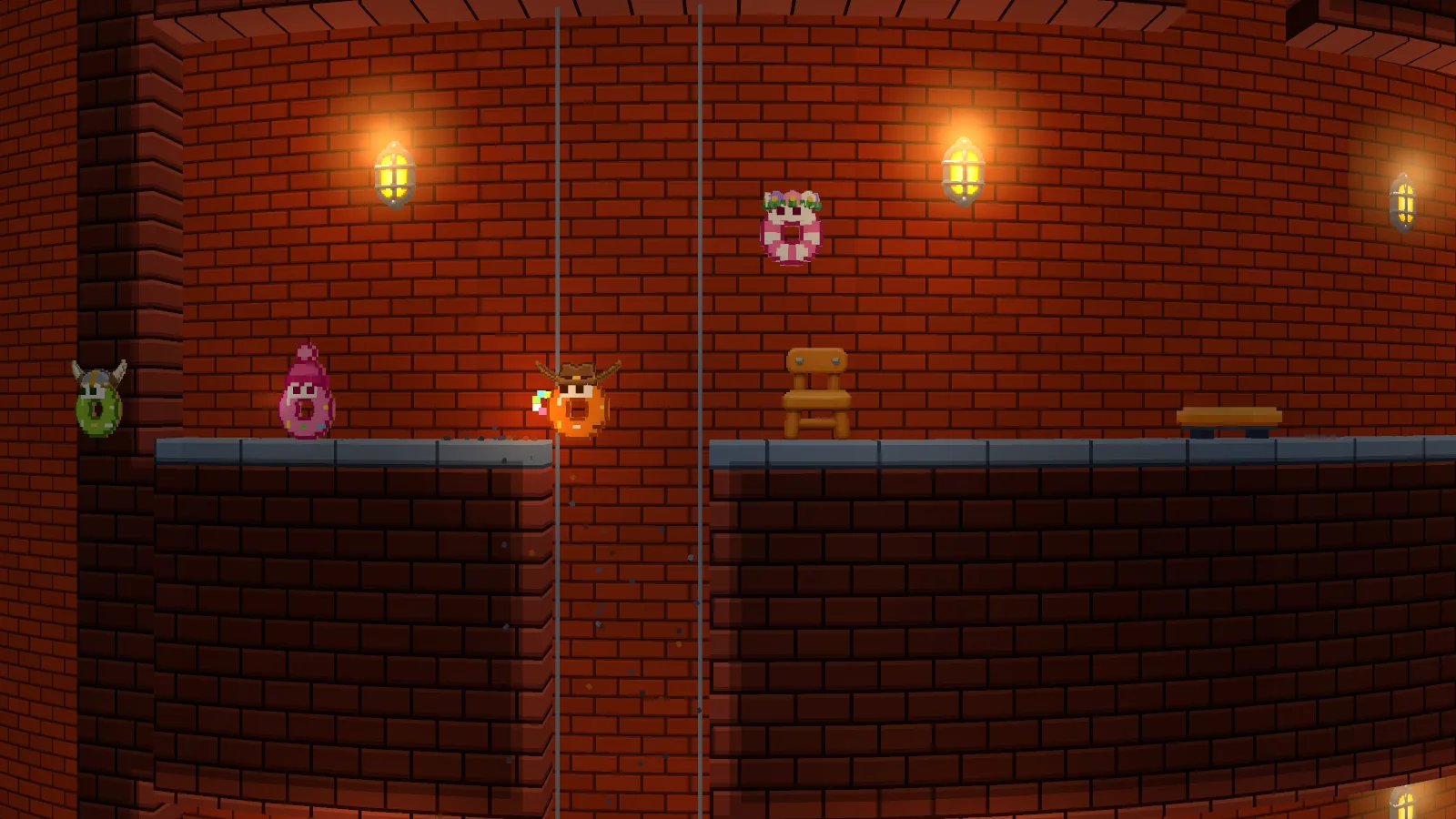
Dark levels have no ambient light at all. You see only what lanterns, glowing mushrooms or the green glow of sludge light up. The renderer picks the sixteen lights closest to the centre of the shot and computes them into a map where one point is one cube. That is why the light falls cube by cube and fits the rest of the picture.
A level from a text file and a drawing
Every level has two parts. Its shape and collisions come from a plan, a plain text file where one character is one cell of seven cubes:
.........................C..
    ..............====.......##
    ...S.......%%......**....##
    ########.....~~~~~~~#######
    ########~~~~~~~~~~~~#######

    # ground     = platform     % crumbling platform
    * breakable block  ~ sludge  S start  C goal
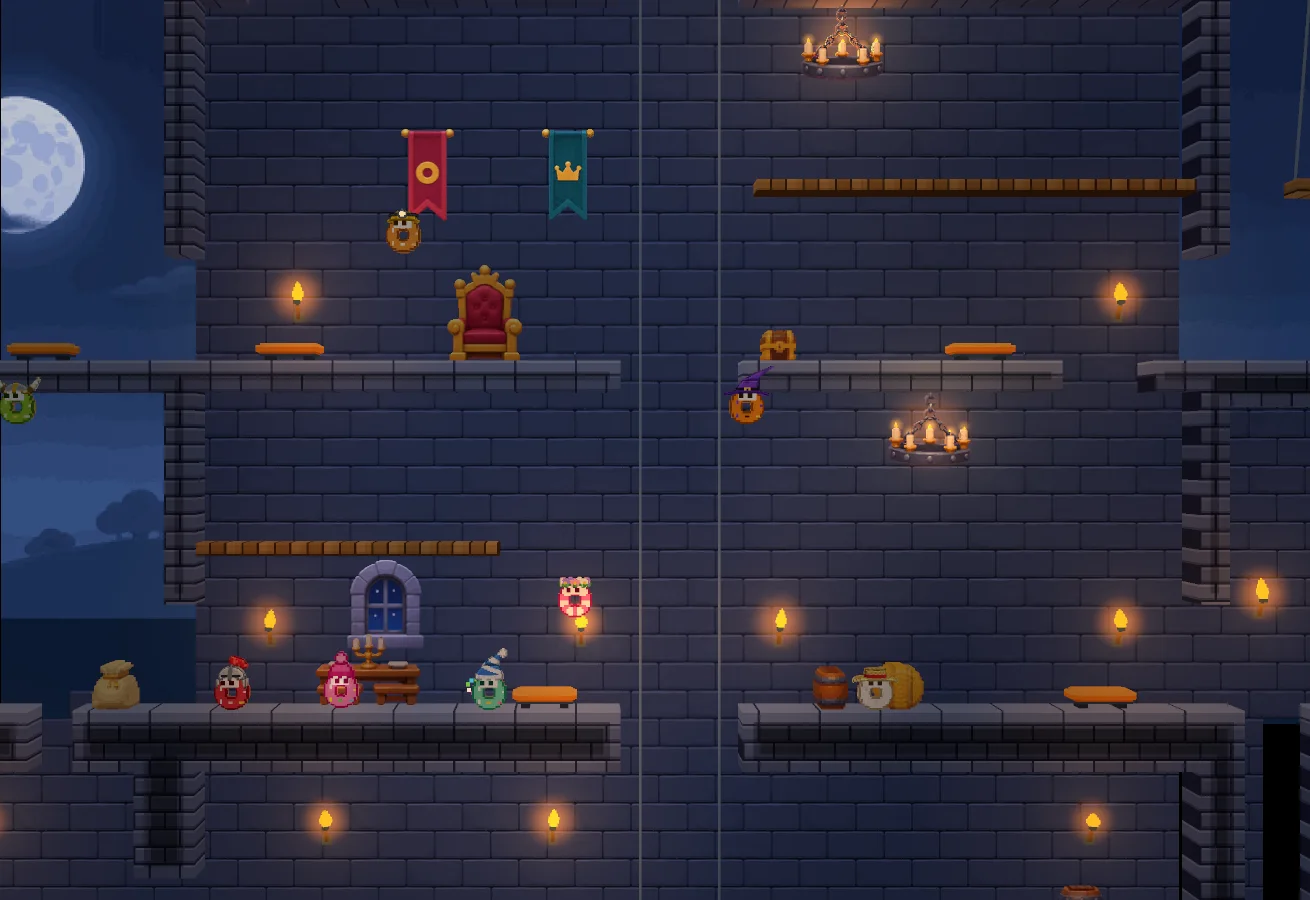
The look comes from pixel art drawings. They are made with the help of AI to our brief, and only the ones we approve get into the game. A converter finds the pixel grid in them, cleans up the palette and turns every pixel into a column of cubes. One pixel of the drawing is one cube in the game; nothing is scaled down or redrawn. A pipe from the drawing gets the shape of a cylinder from its outline, a poop the shape of a little mound.
Because the shape of a level comes from the plan and not from the picture, the level is always playable. The drawing can be as wild as it likes; the platform is where the plan puts it.
Tests that finish the game for us
The worst bug in a platformer is a spot you cannot get out of. Finding those by hand takes weeks. Here the computer looks for them: a test walks through every state the donut can reach in a level and checks that from every place you can stand there is a way to the goal. Another test makes sure every poop can be squashed starting from the beginning of the level, and an autopilot drives every level from start to finish.
That lets us change levels every day without worrying that we left a dead end somewhere.
Arena: eight players, no waiting for the server
In the arena nobody wants to press jump and wait for a server to allow it. So every device computes its own donut and its own shots, and sixty times a second tells the others where it is. The server only passes messages along; it does not run the game.
- Devices measure the network delay between each other. They then draw an opponent where they are right now, not where they were when the message was sent.
- The shooter decides a hit. What you hit on your screen counts.
- Messages carry the latest state. When one gets lost, the next one replaces it and nothing stalls.
- Co-op for two runs without a server. The phones find each other on the same Wi-Fi and connect directly.
We build it with AI, every day
The first line of Donutello 2 was written on 9 November 2026. We build the game, the drawings and this website with the help of artificial intelligence, which is why development moves fast: a new level or arena map takes a day, not a month. But what stays in the game is decided by the people who play it.
The game is not finished yet. What is playable now and what is in the oven is listed on the home page.